 |
Bucks County Fine Arts Gallery, Inc. is a
member of the
Arts & Cultural Council of Bucks County
For a complete listing of local artists and
services go to:
member of the
Arts & Cultural Council of Bucks County
For a complete listing of local artists and
services go to:


 | |  | |  | |  | |  | |  | |  | |  |
Bucks County Impressionist Modern Impressionist New Hope Impressionist
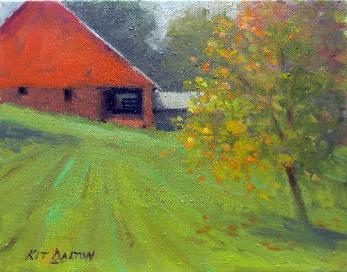
linseed oil -- a tawny-colored oil derived from the seed of the flax plant. They would paint their barns with a linseed-oil mixture, often consisting of additions such as milk and lime. The combination produced a long-lasting paint that dried and hardened quickly. (Today, linseed oil is sold in most home-improvement stores as a wood sealant). Now, where does the red come from? In historically accurate terms, "barn red" is not the bright, fire-engine red that we often see today, but more of a burnt-orange red. * Farmers added ferrous oxide, otherwise known as rust, to the oil mixture. Rust was plentiful on farms and is a poison to many fungi, including mold and moss, which were known to grown on barns. These fungi would trap moisture in the wood, increasing decay. Regardless of how the farmer tinted his paint, having a red barn became a fashionable thing. They were a sharp contrast to the traditional white farmhouse. As European settlers crossed over to America, they brought with them the tradition of red barns. In the mid to late 1800s, as paints began to be produced with chemical pigments, red paint was the most inexpensive to buy. Red was the color of favor until whitewash became cheaper, at which point white barns began to spring up. Today, the color of barns can vary, often depending on how the barns are used. |
WHY ARE BARNS ALWAYS RED?